Pages

Showing posts with label historical fiction. Show all posts

Friday, February 19, 2016

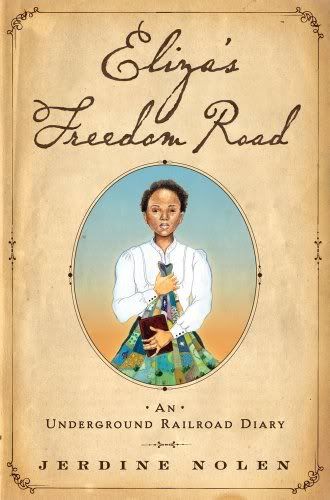
Eliza's Freedom Road review

Eliza's Freedom Road
by Jerdine Nolan
Simon & Schuster
January 2011


First line, "Dear Reader, I am Eliza. Not the girl, but the grown woman Eliza. It has been many years since I was called Eliza. I call myself Elizabeth now."

12 year-old Eliza lives as a slave in the 1850's in Alexandria, Virginia. As a house slave, she enjoys a comparative number of advantages but still must endure many injustices. She is friends with the house cook, and therefore eats well. Her half-blind mistress has taught her how to read (an unusual advantage for a slave) so that Eliza can read her letters and newspapers. Eliza even has a small diary that she is able to keep. Her mother has sewn her a beautiful quilt, with each quilt square representing a traditional folktale. But Eliza's mother has recently been sent away, and there is talk that Eliza may be sold next. She decides to make a break for it, and the bulk of the story, in diary format, is about her year-long journey northward to Canada by night. Alternating between stories of Eliza's escape and traditionally-inspired folktales, this book reminded me just a little bit of The Wanderer by Sharon Creech.

Eliza is an oddly formal little girl - her tone is a bit stilted, and she never uses contractions, but that may be a reflection of the proper speech of the 1850's. As a "house slave" with a bit of education, she doesn't employ colloquial slave speech. The book culminates in a meeting with the legendary leader of the Underground Railroad, Harriet Tubman. True to history, Tubman is a gruff, no-nonsense figure.

An impressive amount of backmatter helps young readers put everything in perspective. There is an author's note, as well as some information about the background of the folktales within the tale. There's also a bibliography of other resources and a list of websites, which I always think will date a book quickly, but certainly have plenty of use at the moment.

The book wraps up very quickly, with a few amazing coincidences that leave our heroine safely reunited with her mother, who has also escaped by the story's end. I'll recommend this to anyone who has exhausted the Dear America series or for those readers who might appreciate the formal prose that takes you to another century.

Compare to:
The Wanderer - Sharon Creech
I Thought My Soul Would Rise and Fly - Joyce Hansen
A Picture of Freedom - Patricia C. McKissack

I borrowed this book from the library.

Friday, May 15, 2015

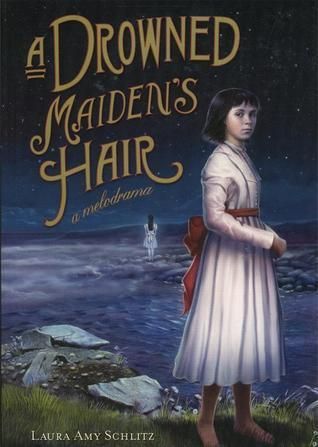
A Drowned Maiden's Hair review

A Drowned Maiden's Hair
by Laura Amy Schlitz
Candlewick Press
January 2006

It's the early 1900's and poor Maud Flynn believes it's her lucky day when she's finally rescued from the Barbary Asylum orphanage she's been living at by three spinster ladies. She quickly realizes, however, that the elderly Hawthorne sisters only wish to use her as a confederate in their fake seances to cheat wealthy bereaved patrons. Maud is desperately lonely and sad. Her only real friend is Anna, also known as "Muffet," the deaf kitchen help. 

The aunts are busy prepping Maud for their grandest heist yet, as well-to-do Mrs. Lambert will pay any price in her attempt to communicate with her drowned daughter Caroline. Maud's job is to hide inside a tiny cabinet and provide ghostly sound effects. Desperate for approval from anyone, love-starved Maud reluctantly goes along with the Hawthornes' scheme. The somber mood of the book is heavily influenced by the setting, a crumbling seaside resort. This story provides a fascinating look at spiritualism and charlatan mediums, a huge fad of the era. Luckily, there is a happy ending for Maud when Mrs. Lambert finally rescues her from the orphanage after her "aunts" abandon her in a fire. I highly recommend this riveting read.

Compare to:
Alchemy and Meggy Swann - Karen Cushman
Penny from Heaven - Jennifer L. Holm
Coraline - Neil Gaiman
The Wolves of Willoughby Chase - Joan Aiken

I borrowed this book from the library

Tuesday, May 12, 2015

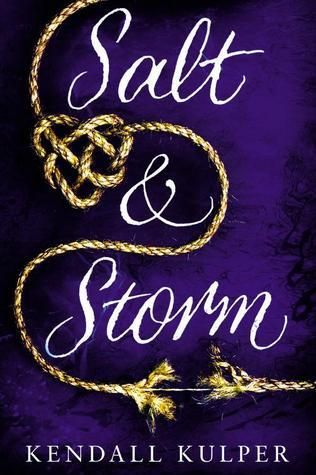
Salt and Storm review

Salt & Storm
by Kendall Kulper
Little Brown Books for Young Readers
September 2014

First line: "Despite my mother's best efforts, I never forgot the day my grandmother taught me to tie the winds."

Sixteen year old Avery Roe is descended from a long line of witches who offer powerful charms and protection to the sea-faring folk of Prince Island. Mysteriously, her mother eschews the tradition, preferring to live in town with her wealthy husband. Avery's grandmother is exhausted and nearing the end of her powers, but is waiting for her granddaughter to escape her mother's control and finally take the reins. During the late Victorian period, whaling is still a way of life for the islanders, but the worlds is changing fast, and magic in general seems to be on the wane. Avery is eager to tap into her magical heritage, but is stymied by remaining under her mother's thumb. She is able to interpret dreams, and sometimes has a flash of weather magic, but most spells remain beyond her ability. All she knows is that it is rumored that her family's magic is powered by pain. She tries cutting herself, which doesn't seem to help.

When she dreams of a whale being caught and slaughtered, she's certain that it prophecies her own murder. Desperate to gain access to her magic, she ends up enlisting the help of Tane, a tattooed South Sea islander with his own magical abilities. Tane sounds like a dreamboat - tan, handsome, and sexy. The two of them start an intense, secret romance.

The secret to the power of the witches of Prince Island was not hard to guess. It is only surprising that Avery takes so long to suss it out. Spoilers ahead: the witch's magical powers are powered by pain - specifically, the pain of losing a loved one. For generations, the women of the island have had a passionate love affair gone wrong, which ended in the heartbreaking loss of the man in her life, and a pregnancy with a girl child to carry on the tradition. Avery's mother thinks she will outwit the "curse" by deliberately getting pregnant with another man's child, and later settling down with her true love. She avoids explaining the ins and outs of how the magic works, in hopes of sparing Avery from becoming the next witch, which of course, completely backfires. The sudden death of Avery's love interest was disappointing. It seems that in a convoluted way, Avery's mother has found a way of breaking "the curse" of their family, which is just well, since witch's seafaring charms hold less and less value in an increasingly industrialized world. Even though Avery's mother is the "villain" of the story, readers will come to understand why her own tortured history and her love for her daughter causes her to behave the way she does.

Compare to:
A Great and Terrible Beauty - Libba Bray
A Drowned Maiden's Hair - Laura Amy Schlitz
House of Ivy & Sorrow - Natalie Whipple
The Vespertine - Saundra Mitchell

I purchased a copy of this book.

Friday, March 13, 2015

Year of the Bomb review

The Year of the Bomb
by Ronald Kidd
Simon & Schuster
June 2009

First line: "There were Martians in the backyard."


In Sierra Madre, California, 1955, Paul and his three best friends Oz, Crank and Arnie are obsessed with monster movies. The War of the Worlds inspired opening, where Martians have seemingly landed, will not fail to draw readers in.  Paul and his friends are overjoyed to learn that Invasion of the Body Snatchers will be coming to film in their downtown.

It really is amazing to think that this juxtaposition of events: monster movies and world altering break-throughs in physics, including work on nuclear bombs, were all happening within a 15 mile radius. While Paul and his friends enjoy a lot of freedom - they ride their bikes, or bus around town, with no fear of crime, the negative sides to the 1950's are also highlighted. Hollywood Boulevard has yet to become a seedy (and later still, commercialized and gentrified) place.  The book touches lightly on the Hollywood blacklist as well as the pressures that families (especially fathers) felt at that time to financially keep up with the Joneses.  

There's a wonderful contrast in this novel between the (artificial) fear that Paul loves to inspire in himself watching monster movie matinees vs. the very real daily fears that he struggles with.  He genuinely fears nuclear attack, and family dynamics are tense as his father slogs away in a top-secret military job that he hates in order to pay the bills.  The other boys families have similar problems.  Paul is soon drawn into some FBI intrigue, as one of the female extras on the set (who Paul immediately develops an innocent crush on) starts spying on her fellow castmates, looking for signs of Communist sympathizers.

I thought it strained credulity that the four boys would gain such easy access to the movie set, as well as famed physicist Richard Feynman's office.  They literally show up and start grilling Feynman with questions.  Feynman answers them in full and pours his heart out to the boys.  Still, it's an enjoyable read and Kidd definitely manages to transport you to another time.

Compare to:
Rex Zero and the End of the World - Tim Wynne-Jones
Penny From Heaven - Jennifer L. Holm
Okay for Now - Gary D. Schmidt


I borrowed this book from the library.
Friday, May 9, 2014

Stonewall Hinkleman review

Stonewall Hinkleman and the Battle of Bull Run
by Michael Hemphill and Sam Riddleburger
Dial Books
April 2009

First line: "All right, let's get the whole name thing out of the way quickly. My name is Stonewall Hinkleman."

Stonewall Hinkleman is tired of being dragged to his parent's Civil War re-enactments every weekend. He'd much rather be curled up at home, eating junk food, and playing with his Game Boy than sleeping in makeshift tents and roughing it without "farby" modern conveniences. His father has drilled into him the importance of respecting history, especially since Great-Great-Uncle Cyrus died in the Civil War. Stonewall sarcastically reminds his dad that Cyrus was shot in the butt and died of infection. Nothing heroic about that.

Stonewall's whining is a bit grating at first. Readers who stick it out for the first two chapters will be rewarded when Stonewall's bugle magically sends him back in time to the real Civil War. As far as time traveling goes, Stonewall says, "I've always hated it in movies when somebody goes back in time and it takes them half of the movie to stop saying, 'I must be dreaming.' No, you know right away. At least, I do."

Freshly arrived at the Battle of Bull Run, Stonewall runs into his ancestor, Cyrus, and soon realizes that staunch modern-day Confederate Mr. Dupree has traveled back as well, hoping to change the course of history. Dupree has carelessly brought his daughter Ashby along with him, whom Stonewall is nursing a small crush on. Cyrus turns out to be much more literate and recklessly brave than Stonewall could have imagined. I appreciated that the authors took care to point out negative aspects such as the scariness of battle, the racism of the day and the greediness of the sutlers without being too overwhelming. Stonewall Jackson's transformation to a modern-day hippie is a bit of a stretch, but anything's possible. This is a satisfyingly fun time-travel adventure. Readers will sense that Stonewall Hinkleman prevails at the end, but it certainly is fun seeing how he gets there.

Compare to:
Bull Run - Paul Fleischman
Charley Skedaddle - Patricia Beatty
With Every Drop of Blood - James Lincoln Collier and Christopher Collier
Jefferson's Sons: A Founding Father's Secret Children - Kimberly B. Bradley

I borrowed this book from the library.
Friday, December 13, 2013

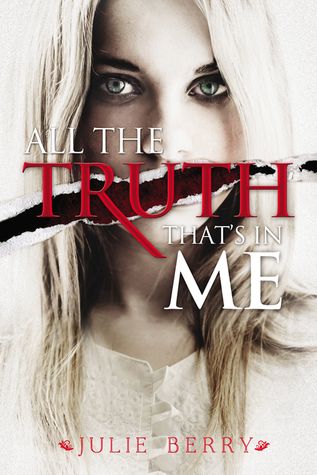
All the Truth That's In Me review

All the Truth That's In Me
Julie Berry
Viking Juvenile
September 2013

First line: "We came here by ship, you and I."

If Arthur Miller's The Crucible met Laurie Halse Anderson's Speak, this would be the result. Judith has survived years of harrowing captivity. Her kidnapper has finally released her from the tiny cabin that she's been trapped in, but not before cutting out her tongue. Judith returns to her tiny Puritan village, and faces the scorn and disgust of her neighbors who question her moral purity and shun her. Make no mistake, this is an intense read, with none of the light-hearted magical touches that fans of Berry's middle-grade fantasies may be accustomed to. 

The book is addressed from Judith to Lucas, the young man that she's been secretly in love with for many years.  Her obsession with Lucas, and her initial inability to speak has shades of The Little Mermaid to it.

Although everyone assumes that Judith was violated during her capture, she is unable to tell them what really happened. There's also the mystery of what happened to her friend Lottie who disappeared around the same time. Gradually, with the encouragement of her friend Maria, Judith opens up and begins practicing how to speak again. Against her mother's wishes, she tries to attend school, but even the schoolmaster sleazily demands "extra lessons" with her, with the gross implication that he's delighted she won't be able to report him for any impropriety. The theme of "finding her voice" is not too heavy-handed, and though it's a slow start, once you settle in to Judith's world, there's a very satisfying conclusion.

I can think of a few teens who were fascinated by the recent kidnapping case in Ohio who would want to pick up this intense novel. I'd also recommend this to readers of psychological thrillers.

Compare to:
Room - Emma Donaghue
I'd Know You Anywhere - Laura Lipmann
Speak - Laurie Halse Anderson


I received a free copy of this book.

Friday, March 29, 2013

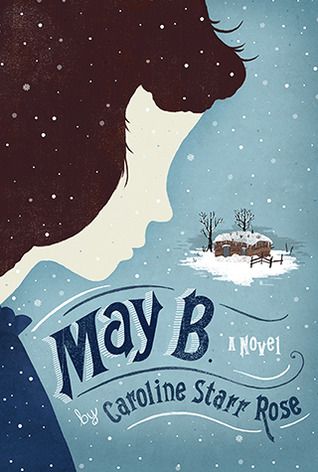
May B. review

May B.
by Caroline Starr Rose
Schwartz and Wade
January 2012

First line: "I won't go."

Twelve year old Mavis Elizabeth Betterly is sent by her parents to help out a new couple settling on the Kansas prairie in the 1870's. Spare narrative poetry immediately conveys the feel for the lives of hardship that May and her family lead. Descriptions of pioneer food are particularly striking: fresh meat, tinned fruit, plenty of coffee, maybe a biscuit. May struggles in school, but is fighting to be able to finish, because she really wants to become a teacher one day. The deck really seems stacked against her: few people in their community acquire more than an eighth-grade education, her parents need her to drop out to work for them, she's a girl and therefore seen as unworthy of much schooling anyway and worst of all, she's struggling with undiagnosed dyslexia. She's madly jealous of her older brother Hiram, who doesn't appreciate all the advantages he's been given.

Life on the Oblingers' settlement is no easier than at home. Their sod house is poorly made, dingier and dirtier than most. The new Mrs. Oblinger, only a few years older than May, suffers from crippling depression and May is quickly overwhelmed and lonely. 

Things come to a head when the Oblingers abandon May without warning, deciding that life on the prairie is too tough for them. May is forced to winter alone, until help will finally arrive. I found the ending a little over the top and unbelievable - May survives a fierce blizzard by the luckiest chance - but the target middle-grade audience probably won't mind.

Short chapters, and free verse make for a blazing fast read.

Compare to:
Hattie Big Sky - Kirby Larson
Out of the Dust - Karen Hesse
Little House on the Prairie - Laura Ingalls Wilder

I received a free copy of this book from the publisher.

Wednesday, February 27, 2013

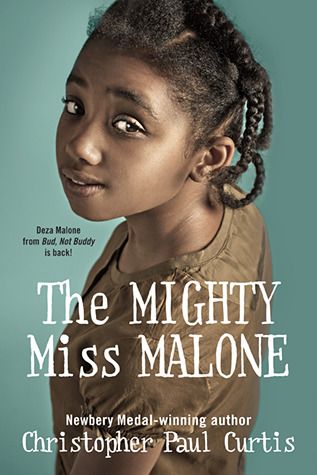
Mighty Miss Malone review

The Mighty Miss Malone
by Christopher Paul Curtis
Wendy Lamb Books
January 2012

First line: "Once upon a time... If I could get away with it that's how I'd begin every essay I write."

Tenacious 12 year old Deza Malone handles everything life throws at her with irrepressible spirit in this  companion novel to Bud, Not Buddy. Starved for work during the Great Depression, her father disappears and the family attempts to reunite with him by traveling across the country. They end up in a "Hoovertown" - an improvised tent city full of other folks down on their luck. This is the first book with a female protagonist that Curtis has written - I enjoyed his attempt, even if I thought he writes a male voice much better.

Deza's a promising student, but school becomes difficult if not impossible with all of the family's financial difficulties that drag them down. Her teeth are rotting so badly, that she nearly faints from the pain, and of course, paying a dentist is completely out of the question. This all sounds pretty grim, but luckily Deza and her brother Jimmy approach everything with such pluck and humor the book is actually a fairly amusing read. Deza makes everything sound like a grand adventure, even living out of a tent in a park.

This seems like a good introduction to the Depression era for children. Plenty of serious topics like racism, homelessness and poverty are explored but never at a level that children will find inaccessible or too overwhelming. Despite the blatant racism the Malone family has to face, there is an upbeat ending - things get wrapped up pretty neatly. 

Compare to:
Roll of Thunder, Hear My Cry - Mildred D. Taylor
My Name is Sally Little Song - Brenda Woods
Bud, Not Buddy - Christopher Paul Curtis

I borrowed this book from the library.

LinkWithin

Related Posts with Thumbnails